

Research current to October 10, 2026. This article is an educational workflow guide, not investment, accounting or legal advice. Never upload confidential client material to an AI tool without authorization.
Quick answer—AI due diligence checklist: AI can help an investment banking analyst find the right questions faster, assemble public-company facts and flag mismatches. It should not be treated as an authority for transaction conclusions. The analyst still needs to identify the original filing, reconcile periods, test adjustments, verify comparables and provide a traceable evidence trail before a VP or deal team can rely on the work.
Why now? In its mid-year 2026 M&A outlook, PwC described an AI-influenced market with larger transactions, uneven deal volume, and increasing use of AI in diligence and valuation. Meanwhile, an October 1 Reuters report cited LSEG data showing $993 billion in global Q3 M&A activity, a 41% sequential decline. Those figures describe market conditions, not a forecast that all deal pipelines will fall. They do explain why quality, speed and defensible assumptions matter to bankers navigating selective transactions.
What does AI-assisted M&A due diligence actually mean?
It means using approved technology to organize, search and compare evidence—not delegating judgment or confidentiality. For public companies, foundational material may include SEC Forms 10-K and 10-Q, earnings releases, merger agreements and other disclosures. For private targets, access to a data room or management information is permissioned. Do not assume you can send that material to a general-purpose AI model.
For public issuer data, the SEC documents EDGAR APIs that expose filing history and XBRL financial facts. The SEC also cautions that facts may carry different reporting dates. This is why a quick automated revenue extraction still needs fiscal-period and source verification.
AI due diligence checklist: 10 source checks for investment bankers
1. Identify the right entity
Check the legal issuer, CIK, ticker, subsidiary relationships and any recent reorganization. A similar company name is not proof of a matching entity. Preserve the issuer identifier beside each metric and source.
2. Pin the filing and reporting period
Write down the exact filing form, filing date, fiscal year-end, accession reference and reporting currency. A fiscal 2026 annual figure is not automatically comparable with another company’s calendar 2026 figure.
3. Reconcile revenue and EBITDA separately
Extract revenue from primary statements and footnotes; define how adjusted EBITDA is calculated rather than assuming it is GAAP. Document exclusions, recurring charges, restructuring adjustments and any differences between management-defined and analyst-defined figures.
4. Validate operating cash flow and capital intensity
Check cash flow statements, capex and working capital. Compare earnings growth with cash conversion. In capital-intensive, AI infrastructure, energy and technology businesses, capital requirements may affect financing capacity even when reported revenue rises.
5. Verify net debt and capital structure
Build a date-stamped debt schedule: cash, revolvers, term loans, bonds, leases when relevant, convertibles, maturities and covenants. Tie the schedule to the source. Do not let an AI tool silently interpret every liability as debt, or every restricted cash balance as available liquidity.
6. Define the comparable universe
Separate business-model peers from mere ticker neighbors. Check geography, revenue mix, margins, growth and capital intensity. Make selection and exclusion rules visible to the reviewer. A good comp set can be defended, not just generated.
7. Bridge enterprise value to equity value
Make the treatment of cash, debt, minority interests, investments, diluted shares and other adjustments explicit. Present both observed inputs and analyst judgments. Audit formulas and sign conventions.
8. Stress-test the valuation assumptions
Run sensitivity cases for growth, margin, WACC, terminal assumptions and multiple selection. In a market where borrowing costs and strategic outlooks can move quickly, a single-point enterprise-value conclusion can obscure the real risk. Keep assumptions distinct from reported facts.
9. Maintain an evidence ledger
For every material claim, capture the source URL or data-room reference, page or note, period, extraction date, reviewer, calculation and unresolved flags. Any number without provenance should be labeled unverified, not silently inserted into a pitchbook.
10. Run pre-submission QA
Compare the model, charts, deal summary and pitchbook. Check totals, units, dates, formulas, citation links and whether a caveat was dropped in the executive summary. Your VP should be able to reproduce a key conclusion without reverse-engineering an opaque AI response.
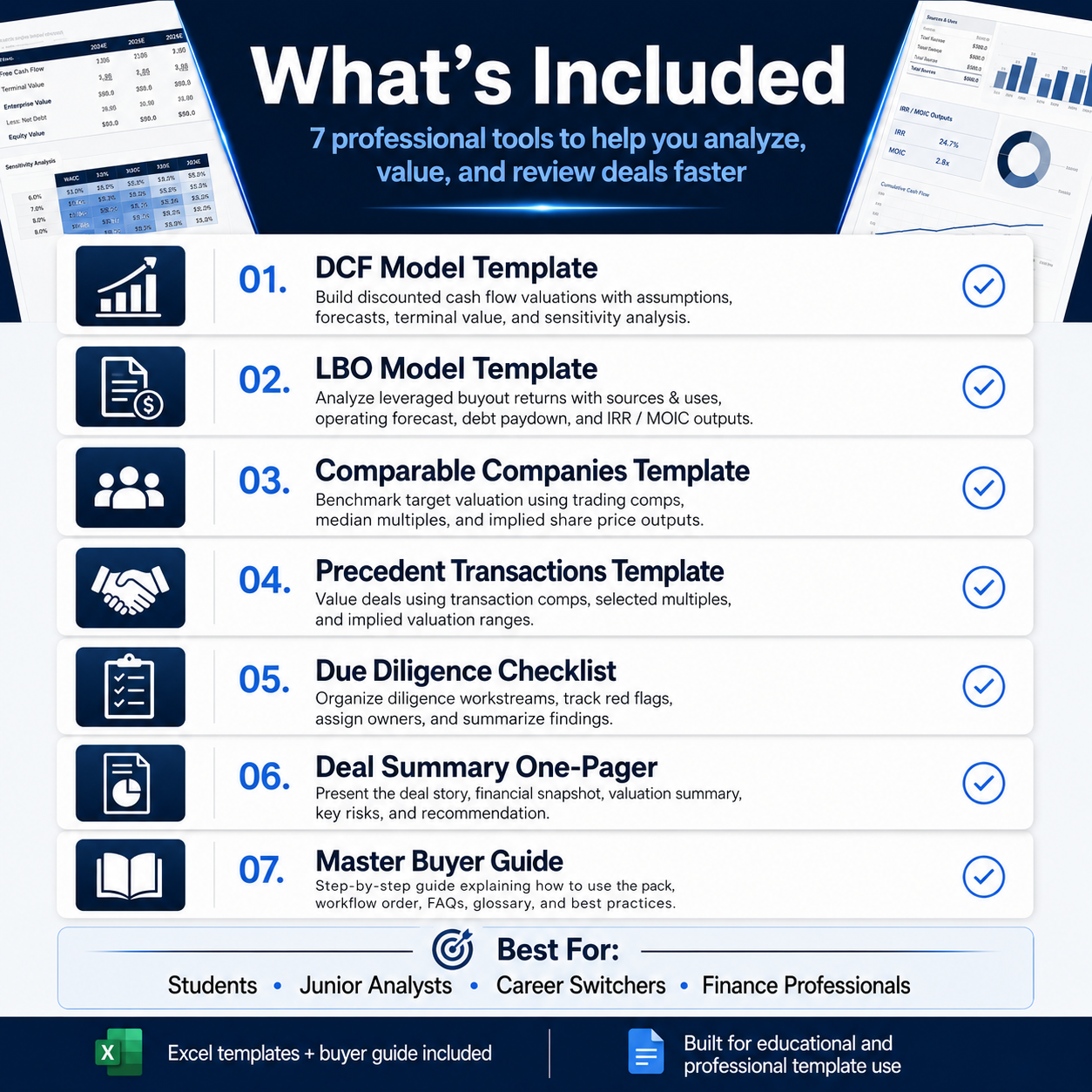
Turn the framework into a deliverable: ToolsUnpacked’s M&A Financial Modeling Template Pack provides starting templates for DCF, LBO, comps, precedents, diligence and a deal summary. It is a modeling resource, not an automated opinion or a replacement for firm-approved research systems.
Example: how an AI-generated number can go wrong
Suppose an AI assistant reports that Target A has $12 billion of revenue and Target B has $10 billion. The answer may look precise yet still be unusable if one number is trailing-twelve-months revenue, the other is annual revenue from an earlier fiscal year, and one figure is presented in a different currency. A reviewer should ask: Which exact filing? Which period? Which unit? Is this restated? Which issuer? If any answer is missing, the comparison should remain provisional.
This discipline is especially important for financial data generated from XBRL. The SEC’s EDGAR API page explains that reported frames can have differing start and end dates. A fast extraction is useful; a period-matched, source-linked and independently checked extraction is banker-ready.
The three-layer workflow to build before buying more AI software
| Layer | Purpose | What the reviewer needs |
|---|---|---|
| Source | Retrieve and preserve filings or authorized diligence materials | Exact document, issuer and period |
| Analysis | Model values, adjustments, comps and scenarios | Assumptions, formulas and exceptions |
| QA / approval | Verify what will enter a pitchbook or investment memo | Reproducible evidence and sign-off |
Use approved AI tools only within the first two layers, with human review before external circulation. Keep client data segregated, preserve access controls and respect source licenses.
Where an analyst should not rely on AI alone
AI should not determine whether a private target’s management add-backs are defensible, whether a transaction satisfies regulatory requirements, or whether a debt instrument’s restrictions permit a planned financing. Those require the relevant finance, accounting, legal and credit professionals. Avoid using a public chatbot with material nonpublic information or confidential documents. Follow your employer’s information-security and data-use policies.
FAQ
Can AI replace financial-model QA?
No. It may identify inconsistencies, but an accountable reviewer still needs to test model mechanics, sources, assumptions and presentation.
Which filings matter most for public-company diligence?
The answer depends on the question. A 10-K offers annual statements and risk disclosures; a 10-Q updates interim results; 8-K disclosures may report material events. Review footnotes and subsequent developments as needed.
What is the best way to avoid hallucinated citations?
Require a resolvable primary-source link, document date, pinpoint reference and a separate verification step. An AI citation that looks plausible is not evidence until someone checks it.
Your next analyst workflow
Start with one company and build a mini evidence ledger: identify the issuer, pin a filing period, source revenue and cash flow, define adjusted metrics, build a comps table and record every assumption. Then conduct an independent QA pass on the numbers and summary.
For a structured starting point, review the ToolsUnpacked M&A Financial Modeling Template Pack. To tighten deck review, see our VP pitchbook sign-off checklist and pitchbook/model QA toolkit guide.
Sources: PwC 2026 mid-year M&A outlook; Reuters, October 1, 2026, on Q3 deal volume; SEC EDGAR data API documentation. ToolsUnpacked product links are commercial CTAs. This article does not claim live access to Bloomberg, Moody’s, S&P or paid data sources.
Prepping for finance or technical interviews?
ToolsUnpacked products are built to help you answer cleaner, avoid preventable mistakes, and show up prepared.
One Comment